Pool Dewatering & High Water Table Management in Tampa
In the Florida peninsula, pool removal is as much about managing the sea as it is about moving concrete. Tampa’s unique limestone shelf and seasonally fluctuating water table create a high-stakes environment where "simple" demolition can quickly turn into a structural crisis.
The "Hydrostatic Pop" Threat
A swimming pool is essentially a concrete boat. When the shell is emptied, the weight of the water inside (often over 150,000 lbs) is gone, but the pressure from the surrounding groundwater (hydrostatic pressure) remains. In high-water areas like **Davis Islands** or **St. Pete Beach**, this pressure can literally "pop" the pool out of the ground—see our groundwater table float risk details—destroying plumbing, foundations, and seawalls in a matter of seconds.
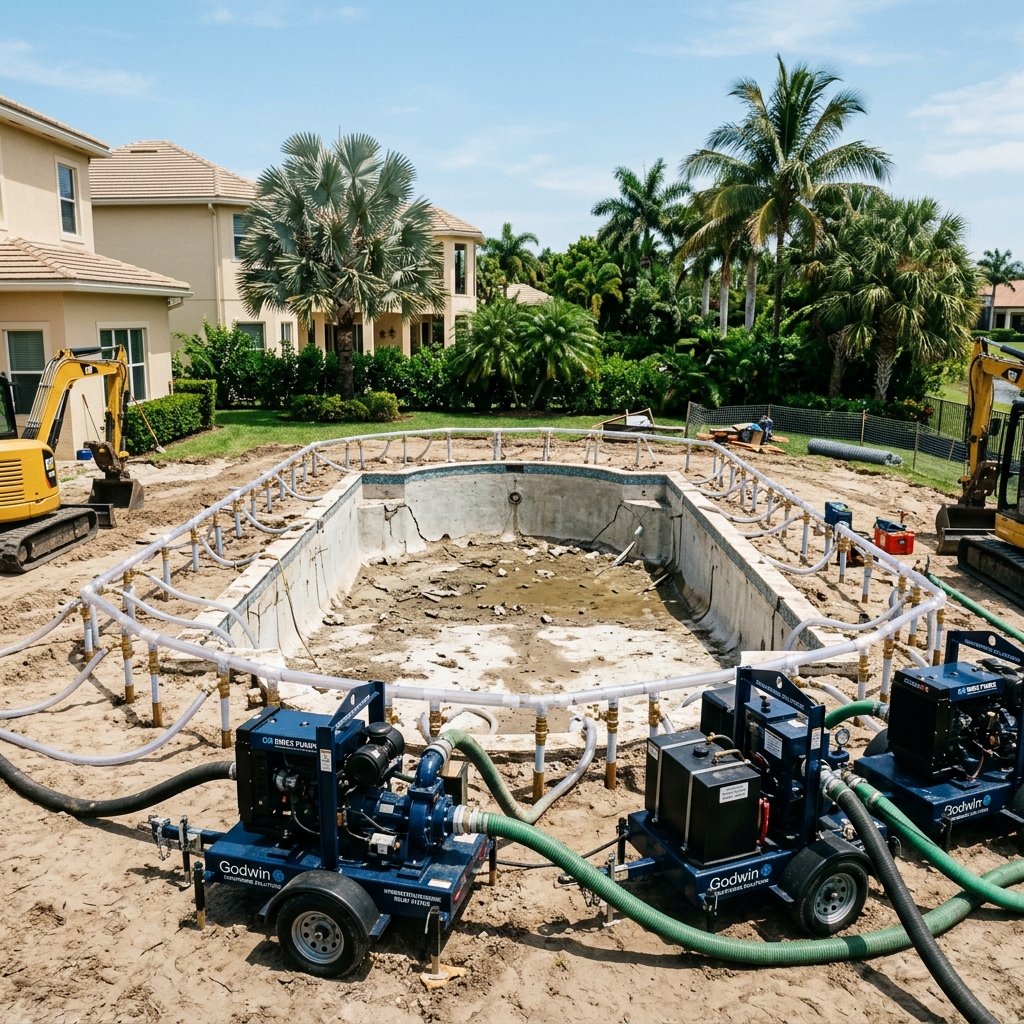
1. The Physics of Groundwater Management
Tampa’s geology is defined by the **Floridan Aquifer System**. In many low-lying areas, the water table can be as shallow as 2 feet below the surface. This creates a "Buoyancy Factor" that must be calculated before the first excavator enters the site.
Professional dewatering isn't just about pumping water out of a hole; it's about **Pressure Equalization**. We utilize a strategy that balances the lateral force of the soil with the vertical force of the water to maintain "Property Equilibrium."
Technical Specs: Hydrostatic Lift
- Water Weight: ~62.4 lbs per cubic foot.
- Pressure Gradient: Increases by 0.433 psi for every foot of depth.
- Critical Point: A 5-foot deep pool in a 3-foot water table faces over 500 lbs of upward force per square foot of floor.
2. Advanced Dewatering Systems
One size does not fit all. We choose the dewatering system based on the soil's hydraulic conductivity.
Well-Point Systems
Used for "High-Risk" deep removals. We install a series of 2-inch diameter pipes (points) around the pool connected to a common header pipe and a vacuum pump. This lowers the water table in a 20-foot radius, allowing for a dry excavation.
Sum-Pumping (The Trench Method)
Appropriate for "Moderate-Risk" sites. We dig a deeper trench adjacent to the pool shell, allowing groundwater to migrate to a central "sump" where it is pumped to a legal discharge point.
Hydrostatic Relief Valves
The "Safety Net." We punch or open the check-valves in the pool floor to allow water into the shell. While this makes for a "wet" demo, it ensures the shell never becomes a boat.
3. The Danger of Soil Liquefaction
In Tampa’s sandy soils, vibration + high water = **Liquefaction**. This is when the sand loses all its load-bearing capacity and acts like a liquid.
If an inexperienced contractor brings a heavy excavator to a wet site and starts hammering, the very ground they are standing on can turn into "quicksand," leading to machine roll-overs or foundation shifting in the neighbor's house.
🛡️ THE EXPERT MITIGATION PLAN
We use **Low-Ground-Pressure (LGP)** tracks and strictly monitor "Pore Water Pressure" during the excavation phase to ensure the sand remains a solid matrix.
Geotechnical Monitoring
We aren't just pool guys; we are amateur geologists. We monitor the "Angle of Internal Friction" of your soil to ensure that our dewatering plan matches the physical reality of your backyard.
Consult an Expert4. SWFWMD & Legal Water Discharge
Where do you put 20,000 gallons of groundwater? In Tampa, you can't just pump it into the street. The **Southwest Florida Water Management District (SWFWMD)** and local municipal codes have strict rules regarding "Siltation" and "Runoff."
Sediment Filtration
We use "Dirt Bags" and silt fences to filter every gallon of water before it leaves your property, ensuring no sand enters the Tampa Bay storm drain system.
Discharge Permitting
Some areas of St. Pete require specific "Temporary Discharge Permits." We handle all the paperwork to ensure your project stays 100% legal.
Tampa Water Table Risk Matrix
| Neighborhood | Risk Level | Required Strategy |
|---|---|---|
| South Tampa (Interbay) | 🔴 EXTREME | Full Well-Point System + 24/7 Monitoring |
| Brandon (Alafia River Area) | 🟠 HIGH | Sump-Trench + Relief Valve Management |
| Carrollwood / Lutz | 🟢 LOW/MOD | Relief Valves + Standard Saturation Monitoring |
| Downtown St. Pete | 🔴 EXTREME | Vacuum Pumping + Seawall Stability Review |
5. Understanding Hydraulic Conductivity in Tampa Sand
Hydraulic conductivity (K) is the ease with which a fluid (water) can move through pore spaces or fractures. In the Tampa Bay area, the native sand has a high K-value, meaning water moves quickly. This is both a blessing and a curse for pool removal.
While it allows for fast dewatering via well-points, it also means that the water table can "recharge" almost instantly if the pumps fail. We calculate the **Seepage Velocity** for every site to determine the redundancy required in our pumping array.
The Darcy Equation in Practice
Q = K * A * (dh/dl)
We use a simplified version of Darcy's Law to predict the "Drawdown Curve" of the water table. This ensures that we aren't pulling water from too far away, which could inadvertently settle a neighbor's swimming pool or septic tank.
Pore Water Pressure Monitoring
As we remove the weight of the pool, the pressure in the water trapped between sand grains (pore pressure) increases. If this pressure isn't managed, it can trigger **"Quick" conditions**, where the soil loses all strength. We monitor this in real-time on high-risk waterfront sites.
Long-Term Ground Stabilization
Once the pool is removed and the well-points are turned off, the water table will naturally "recharge." If the backfill was not compacted at the **Optimum Moisture Content**, the returning water can cause "Collapse Settlement."
Our engineered approach ensures that the new soil matrix is dense enough that the returning water acts as a stabilizing force rather than a disruptive one.
Post-Dewatering Landscape Health
A common concern in Tampa is whether dewatering will kill existing oak trees or palms. Because we use localized well-points rather than open-pit pumping, the "Cone of Depression" is tightly controlled.
We monitor the hydration levels of surrounding vegetation and, if necessary, provide supplemental irrigation during the 72-hour dewatering window to ensure your heritage oaks remain healthy.
Comprehensive Hydrology FAQ
Deep Technical Insights for Florida Landowners
What is 'Drawdown' in dewatering?
Drawdown is the vertical distance the water table is lowered at a specific point. We aim for a drawdown of at least 2 feet below the bottom of the excavation.
Does the City of Tampa require a dewatering permit?
Yes, for any project that discharges more than a certain gallonage into the storm sewer. We handle the permit acquisition for all industrial and residential projects.
What is a 'Confined Aquifer' vs 'Unconfined'?
In Tampa, we deal mostly with the unconfined Surficial Aquifer. However, in some areas, we must be careful not to breach the confining layer of the Floridan Aquifer below.
Can dewatering cause sinkholes?
In very specific geological conditions, rapid dewatering can trigger a collapse if there is a pre-existing Karst void. This is why we perform a site survey before starting pumps.
What is 'Vibratory Installation' for well-points?
We use high-frequency vibration to 'jet' the well-points into the sand, which is much faster and cleaner than traditional drilling methods.
How do you handle 'Silting' during discharge?
We use tiered filtration: a primary settling tank, a secondary 50-micron filter bag, and a final silt fence barrier.
Is the water you pump out 'Clean'?
It is natural groundwater. While it may contain tannins or sulfur (typical for Florida), it is free of chemicals. Our filtration ensures it is free of physical sediment.
What happens if the power goes out?
We use diesel-powered backup generators for all well-point arrays. The water table doesn't wait for the electric company.
Can I use the pumped water to fill my new pool?
We don't recommend it. Groundwater in Tampa often has high mineral content that can stain new pool finishes. It's better to use municipal water.
What is the 'Sphere of Influence'?
This is the total horizontal area affected by our pumping. We map this to ensure your neighbor's well or foundation is outside the zone of significant drawdown.
Hire a Contractor Who Understands Tampa Hydrology
Don't risk your property with a 'Quick-Lube' contractor. Get a hydrological assessment from Tampa's pool removal specialists.