Engineered Pool Backfill & Soil Stabilization Standards
In the Tampa Bay region, a pool removal project is only as successful as the soil that replaces it. With Florida's unique hydrological profile and sandy soil compositions, failing to stabilize the land can lead to catastrophic yard collapse, sink-pockets, and "zombie" drainage issues.
The "95% Proctor" Standard
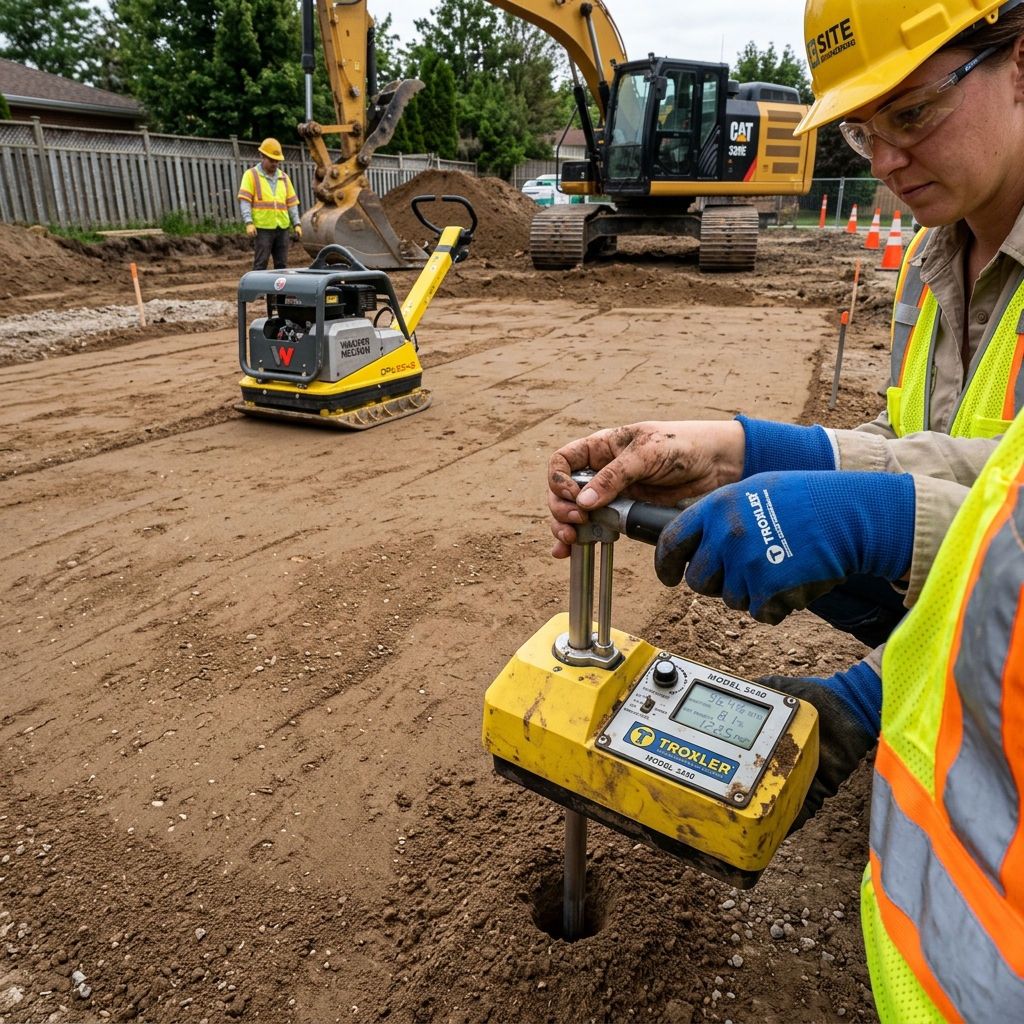
For a lot to be classified as "Build-Ready" after pool demolition, the backfill must reach a **95% Proctor Density**. This is a measure of the soil's dry unit weight compared to its maximum possible density. In Tampa, achieving this requires nuclear density testing and specific moisture-to-compaction ratios that most general contractors simply ignore.
1. The Tampa Hydrological Trap
Unlike the clay soils of Atlanta or the hard rock of Scottsdale, Tampa’s sub-surface is dominated by fine-grained sand and a seasonally fluctuating water table. When you remove a pool shell, you aren't just leaving a hole; you are creating a temporary "void" in the local hydraulic pressure system.
Hydraulic Heave
If backfill isn't porous enough, groundwater can get trapped beneath the new soil, creating a "sponge effect" that causes your lawn to feel soft even weeks after it has rained.
Lateral Migration
Tampa's sandy soil moves laterally. Without stabilization, the pressure from your neighbor's pool or foundation can push into your filled area, causing "stair-step" cracks in new patios.
2. Material Selection & Sourcing
We don't just "buy dirt." We source specific geological materials required for structural load-bearing performance in Florida.
Clean Virgin Fill
We use only virgin, screened fill. Recycled concrete or organic-heavy soil leads to "rot voids" as the organic material decomposes over 5-10 years.
Capillary Break Layers
In high-water areas, we install a layer of #57 stone at the base to act as a capillary break, preventing moisture from wicking up into the surface layers.
Bio-Organic Topsoil
Only the final 6-12 inches consist of nutrient-rich topsoil to support sod or landscaping, ensuring the deep structure remains purely structural.
3. The "Lift-by-Lift" Compaction Cycle
True stabilization is impossible in a single pour. Our crews follow a rigorous **"6-to-12 Inch Lift"** protocol. This is the difference between a yard that sinks and a yard that supports a 20-ton ADU or outdoor kitchen.
- Vibratory CompactionUsing 5,000-lb centrifugal force plates to pack sand particles into a dense matrix.
- Moisture OptimizationAdding water during compaction to reach the 'Optimum Moisture Content,' allowing particles to slide into their tightest formation.
- Nuclear Density VerificationFor high-stakes projects, we utilize independent engineers to verify the 95% Proctor density through a nuclear gauge.
The 10-Year Yard Guarantee
Because we use engineered fill and precision compaction, we are the only Tampa contractor to offer a structural guarantee against significant settling or sinkage.
Get Professional Stabilization4. Future Land Use & Load Bearing
How you intend to use the land determines the engineering spec of the backfill.
For Patios & Pavers
Requires 90% compaction. We focus on horizontal stability to ensure your pavers never shift or "wave" after a Florida thunderstorm.
For ADUs & Structures
Requires 95%+ compaction and engineering sign-off. We provide the "Certificate of Compaction" your builder will need for permit approval.
For Lawns & Gardens
Focus on drainage over extreme density. We ensure the bottom layers are stable while the top layers allow for root penetration and water flow.
Soil Stabilization & Compaction FAQ
Q: What is 'Nuclear Density Testing' for pool fill?
It is a process where an engineer uses a gauge to measure the density and moisture of the soil in real-time. It's the only way to prove to a building inspector that the ground is solid enough to support a new structure.
Q: Can I use 'Free Dirt' from a construction site?
NEVER. Free dirt often contains clay, debris, or organic matter. In Tampa, clay holds too much water and causes 'swelling,' while organics rot and create underground voids (sinkholes).
Q: How long does it take for the soil to settle naturally?
If properly compacted in lifts, settling is negligible (less than 1 inch). If just 'dumped in,' it can settle for 5-10 years, causing anything built on top to crack.
Q: What is a 'Lift' in compaction terms?
A lift is a layer of soil. We fill the pool 10 inches at a time, compact it, and then add the next 10 inches. This ensures the bottom is just as dense as the top.
Q: Do I need an engineer to sign off on the backfill?
If you plan to build a permanent structure (like a house addition) over the old pool, yes. We coordinate with local Tampa engineers to provide this documentation.
Q: How does Tampa's water table affect the soil density?
High water tables can 'liquefy' sand if it isn't compacted correctly. We use specific dewatering techniques to ensure the soil is dry enough to reach maximum density during the process.
The Machinery of Stabilization
Soil stabilization isn't just about the dirt; it's about the energy applied to it. We utilize a fleet specifically chosen for the high-sand, high-moisture environments of the Tampa Bay area.
- Compact Excavators (3-5 Ton): Essential for tight South Tampa lot lines where larger machines would crack neighboring driveways.
- Vibratory Trench Rollers: Remote-controlled rollers that apply high-frequency vibration to deep lifts, ensuring the bottom 4 feet are as dense as the top 1 foot.
- Low-Ground-Pressure (LGP) Bobcats: Specially tracked machines that prevent "churning" the sub-surface sand, which can destroy existing drainage corridors.
Stabilization for Waterfront Properties
If your property is in Snell Isle, Davis Islands, or near the Hillsborough River, your soil stabilization needs are 3x more complex. The proximity to salt water means the water table is likely 2-3 feet from the surface.
⚠️ WARNING: The Hydro-Static Pop
In waterfront areas, removing a pool can cause the surrounding soil to "liquefy" due to pressure imbalances. We use a proprietary dewatering and lateral bracing strategy to ensure your seawall or foundation doesn't shift during the backfill process.
We coordinate with **Florida structural engineers** to ensure that our backfill plan respects the load-bearing requirements of the local coastline, preventing long-term erosion or lateral migration toward the water.
Understanding Proctor Density & Compaction Testing
Most "pool guys" will tell you they "packed it down with the bobcat." In the world of soil engineering, this is called **Static Weight Compaction**, and it only affects the top 2-4 inches of soil.
To reach the **95% Modified Proctor Density** required for building, you need **Dynamic Force**. This involves high-frequency vibration that causes the sand grains to rearrange into their most efficient geometric configuration, essentially "locking" them together.
| Land Use | Required Density |
|---|---|
| Non-Structural Garden/Lawn | 85% - 88% |
| Paver Patios / Walkways | 90% - 92% |
| Foundation Support (ADUs/Kitchens) | 95% - 98% |
| Commercial Load Bearing | 100% |
Advanced Soil Stabilization FAQ
What is 'Lifting' in soil engineering?
Lifting refers to adding fill in layers (usually 6-12 inches). Each lift is compacted individually. If you dump 6 feet of dirt into a hole at once, only the top layer is compacted, leaving a soft, settling core underneath.
Why is Florida sand harder to compact than clay?
Sand is 'non-cohesive,' meaning the particles don't stick together. Clay is cohesive and 'packs' easily but holds too much water. Sand requires the perfect moisture balance to lock into place.
How do you prevent air pockets around the broken concrete?
In a partial removal, we use high-vibration machines to 'shake' the sand into every crevice of the broken pool floor, ensuring no voids remain to collapse later.
What happens if it rains during the backfill?
Heavy rain can actually help with 'hydro-compaction' if managed correctly, but it can also wash out the fines. We monitor moisture content and wait for the 'Optimum Moisture Range' before final compaction.
What is 'Nuclear Density' vs 'Sand Cone' testing?
Nuclear testing is instant and allows us to keep working. Sand cone testing is more traditional but takes 24 hours for lab results. We prefer Nuclear for its speed and accuracy on the job site.
Do you use lime or cement for stabilization?
Rarely in residential pool removals. Lime is used for clay soils. For Tampa sand, we rely on mechanical vibration and moisture control, which is cleaner and more cost-effective.
Can I plant a tree over the old pool area?
Yes, but we must leave the top 3-4 feet 'un-compacted' or use structural soil that allows for root growth. We can customize the compaction levels based on your landscaping plan.
Does the type of fill matter for drainage?
Yes. Using 'Dirty Fill' with too much silt will block drainage. We use 'A-3' sand or clean fill that matches the native Florida soil profile for perfect drainage.
How do I prove the yard is stable when I sell my home?
We provide a signed 'Compaction Report.' This document becomes part of your home's permanent record and is vital during home inspections and title transfers.